
Electroless plating properties
Hardness and Wear Resistance
Hardness
NIPLATE® coatings are characterized by a surface hardness significantly higher than that of the typically treated base materials. This property makes a decisive contribution to the component’s tribological performance, particularly in terms of wear resistance and in-service surface stability.
Compared to traditional and commercially comparable coatings and surface technologies such as nickel electroplating and anodic oxidation of aluminum, electroless nickel coatings often exhibit higher hardness values; these values are comparable to hard chrome, with the advantage of uniform thickness and improved dimensional control. Steel thermochemical treatments (nitriding, carburizing, nitrocarburizing, etc.) can achieve comparable or higher hardness values depending on the process and base material.
Nevertheless, it should be noted that the hardness of electroless nickel coatings remains lower than that achievable with special ultra-high-performance coatings such as plasma spray or PVD/CVD. While these technologies can provide higher hardness, they involve substantial differences in terms of cost, geometric applicability, and process complexity, which limits their use in many industrial applications.
The final hardness of NIPLATE® coatings is strongly influenced by the post-deposition heat treatment, which determines the microstructural evolution of the Ni–P alloy. The table below summarizes the indicative hardness values that can be obtained depending on the heat treatment applied.
| Hardness [HV] | Dehydrogenation 150-180° C x 4h | Hardening 260-280° C x 8h | Hardening 330-350° C x 4h |
|---|---|---|---|
| NIPLATE® 500 | 550 ± 50 HV | - | 1000 ± 50 HV |
| NIPLATE® 600 | 700 ± 50 HV | 800 ± 50 HV | 1000 ± 50 HV |
| NIPLATE® 500 PTFE | 250 ± 100 HV | 300 ± 100 HV | - |
| NIPLATE® 600 SiC | 700 ± 50 HV | 850 ± 50 HV | 1050 ± 50 HV |
To compare a requirement expressed on different scales, use the HV, HRC and HB hardness converter. It provides quick access to the equivalences shown in the ASTM E140 table.
PRACTICAL RECOMMENDATIONS
The maximum hardness of NIPLATE® coatings is achieved by a hardening treatment at approximately 340°C for 4 hours. This treatment results in an iridescent yellow-blue surface coloration due to surface oxidation of the nickel.
If the aesthetic appearance of the coating is a critical requirement, the hardening treatment can be carried out in a controlled or inert atmosphere, achieving equivalent hardness values without altering the metallic color of the electroless nickel.
Wear Resistance
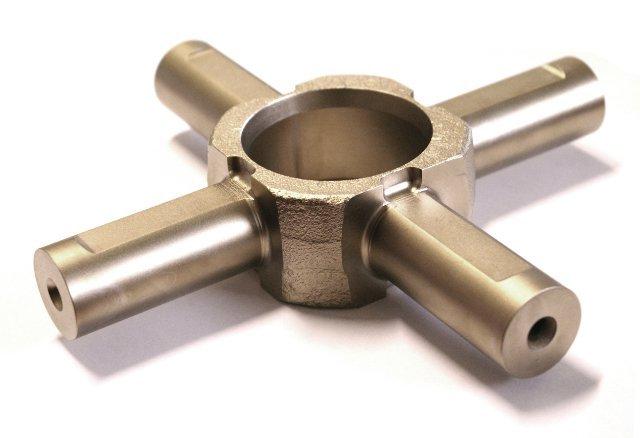
The wear resistance of NIPLATE® coatings results from the combination of high hardness, deposit cohesion, and uniform thickness. In particular, NIPLATE® 600 and NIPLATE® 600 SiC coatings are successfully used in applications subject to abrasive, adhesive, and fretting wear.
With a medium phosphorus content (about 7% in the alloy), NIPLATE® 600 provides high wear resistance in both lubricated and dry conditions. The ability to combine high coating thicknesses (up to 50–70 µm) with hardening heat treatments makes it possible to significantly increase component service life, achieving performance comparable to hard chrome, with the advantage of not requiring subsequent reworking and ensuring uniform thickness even on internal surfaces.
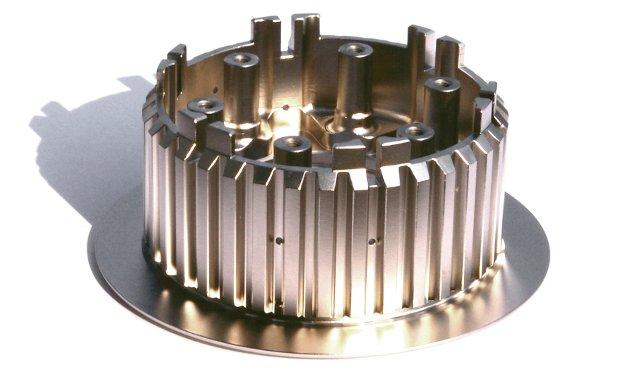
For particularly critical applications, where wear is the main limiting factor, NIPLATE® 600 SiC has been developed. It is a composite coating with a NIPLATE® 600 matrix containing microcrystalline silicon carbide (SiC) particles at a concentration of 20–30% by volume.
Silicon carbide is a synthetic ceramic material characterized by extremely high hardness. Its co-deposition within the electroless nickel matrix gives the coating exceptional abrasive wear resistance, up to 10 times higher than hard chrome. These characteristics make NIPLATE® 600 SiC particularly suitable for high-stress sectors such as racing, textiles, and industrial applications with continuous and severe contact.
PRACTICAL RECOMMENDATIONS
- For components subject to heavy wear, it is recommended to specify a minimum coating thickness of 20 µm, combined with a hardening treatment at 280°C for 8 hours or, preferably, at 340°C for 4 hours, depending on compatibility with the base material.
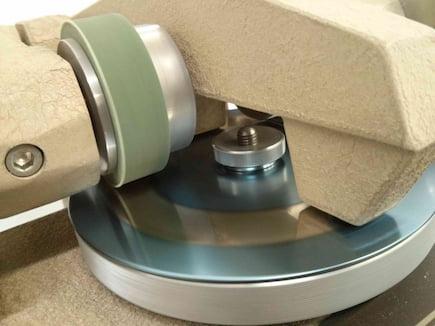
Taber Abraser abrasive wear test
The method most commonly used to evaluate the abrasive wear resistance of electroless nickel coatings is the Taber Abraser Test, referenced by ASTM B733 for autocatalytic Ni-P coatings.
The test is performed according to standardized parameters:
- Abrasive wheels: CS-10
- Load applied on each wheel: 1000 g
- Suction nozzle height: 1 mm
During the test, the specimen is mounted on a rotating turntable and subjected to the combined rolling and sliding action of the abrasive wheels. The wear debris generated is vacuumed away to prevent interference with the measurement.
The test result is expressed as the Taber Wear Index (TWI), calculated as the average weight loss of the specimen, in milligrams, over 1000 cycles. Lower TWI values indicate greater abrasive wear resistance.
The following table lists indicative TWI values for the main NIPLATE® coatings depending on the heat treatment applied.
| Wear resistance [TWI] | Dehydrogenation - 150-180° C x 4h | Hardening - 260-280° C x 8h | Hardening - 330-350° C x 4h |
|---|---|---|---|
| NIPLATE® 500 | 20 TWI | - | 10 TWI |
| NIPLATE® 600 | 16 TWI | 12 TWI | 9 TWI |
| NIPLATE® 500 PTFE | 33 TWI | 19 TWI | - |
| NIPLATE® 600 SiC | 0.70 TWI | 0.65 TWI | 0.60 TWI |