
Electroless plating properties
Coating thickness in Electroless Nickel Plating
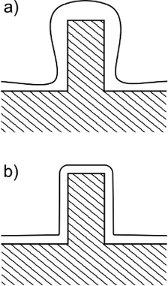
Coating thickness is one of the most important parameters in electroless nickel plating, as it directly affects both the component’s functional performance and compliance with dimensional tolerances. Unlike other surface treatments, electroless nickel plating allows particularly accurate and repeatable thickness control, making it suitable for precision mechanical applications.
Thickness Uniformity
NIPLATE® coatings offer a consistent uniform thickness over the entire surface of the workpiece, regardless of its geometry. This behavior is inherent to the autocatalytic deposition process and represents a substantial difference compared to electrodeposited coatings such as chrome plating or electrolytic nickel plating.
In electroplating processes, thickness distribution is influenced by the electric field, resulting in increased deposit on edges and more exposed areas, known as the “edge effect”. In electroless nickel plating this phenomenon is absent: the layer grows much more evenly, reducing local thickness variability.
This feature, in most cases, makes it possible to avoid post-treatment rework, provided that the coating thickness is correctly taken into account already at the design stage.
Hole masking and post-treatment rework
Thanks to the high thickness uniformity, precision mechanical parts can be designed and machined by accounting for the dimensional change due to coating build-up, allowing the entire part to be nickel plated without the need for rework.
In the case of particularly tight dimensional tolerances, selective masking of holes or functional surfaces may be required. This operation increases process complexity and costs and, for this reason, should be adopted only when it is not possible to meet tolerances through appropriate dimensional compensation during machining.
To support the correct definition of pre-treatment dimensions, the pre-treatment dimensional tolerance calculator is available, useful for quantitatively assessing the impact of nickel plating thickness on the final dimensions of the part.
Selecting the Thickness
The coating thickness must be selected according to the required performance, particularly in terms of corrosion resistance and wear resistance, as well as the environmental operating conditions.
In industrial applications, electroless nickel plating thickness typically ranges from 3–5 µm for light-duty applications up to 50–70 µm for severe operating conditions. Thickness tolerance is generally kept within ±10% of the nominal value, with a minimum of ±2 µm, as shown in the table below.
| Thickness | Tolerance |
|---|---|
| 2–20 µm | ± 2 µm |
| 21–30 µm | ± 3 µm |
| 31–40 µm | ± 4 µm |
| 41–50 µm | ± 5 µm |
| 51–60 µm | ± 6 µm |
| 61–70 µm | ± 7 µm |
Recommended nickel plating thicknesses for corrosion resistance
Defining the optimal thickness is not always immediate, as it depends on multiple factors, including the base material, the operating environment, and the expected service life. For more details on corrosion resistance, see the dedicated section. In some cases, the final thickness selection may require experimental verification or field testing.
The following table provides indicative electroless nickel plating thickness values depending on the operating conditions, useful as a preliminary reference during the design stage. For the correct designation of thickness according to ISO 4527, consult the dedicated section.
| Operating conditions | Description | Coating thickness on ferrous and aluminum alloys | Coating thickness on copper alloys |
|---|---|---|---|
| 1 – Light | Indoor use in a warm, dry atmosphere | 8±2 µm | 5±2 µm |
| 2 – Moderate | Indoor environment with possible condensation or dry industrial environment | 15±2 µm | 8±2 µm |
| 3 – Heavy | Outdoor use with frequent wetting by rain, moisture, or water | 30±3 µm | 15±2 µm |
| 4 – Extremely heavy | Maritime or highly aggressive environment, with frequent exposure to water containing salts at neutral or slightly alkaline pH | 50±5 µm | 20±2 µm |
PRACTICAL RECOMMENDATIONS
- Our technical department is at your disposal to help determine the correct nickel plating thickness, taking all the relevant factors into consideration.
- During machining, the coating thickness must be accounted for as coating build-up: for example, a thickness of 10 µm results in a hole diameter reduction of 20 µm (0.02 mm).
- For metric threads, factor in a diametric deviation equal to 4 times the treatment thickness.
- The pre-treatment dimensional tolerance calculator allows a preliminary check of compliance with final dimensions after treatment.